
Why Plant Iron is Best
By Lee Jerome, MSc Nutrition
One of the oldest nutritional myths is that people who
follow a vegetarian or vegan diet are at greater risk of
iron deficiency anaemia! The reason? Because they don’t
eat red meat, believed by many to be the best and only source
of this vital mineral. This is simply not true and all the
major health organisations agree – the British Medical Association,
the World Health Organisation and the American Dietetic Association.
Despite this, some minor health bodies, health professionals
and health writers persist in recommending red meat as the
best source of iron. Invariably they fail to mention the
possible health risks that go with iron from meat and never
mention the benefits of plant iron. The old myth has developed
deep roots – but it is still a myth. This fact sheet explains
all.
What is Iron and Why Do We Need It?
Iron is a mineral and is an essential component of haemoglobin,
found in all red blood cells. It is vital for the health
of cells and for the transport of oxygen to all parts of
the body.
Sources and Types of Iron
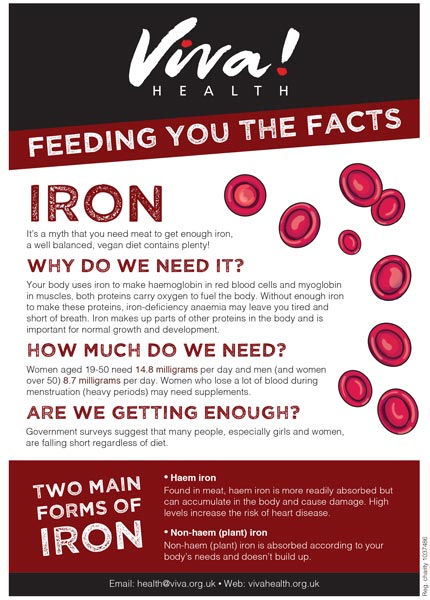
There are two types of iron -
haem, primarily from meat sources, and non-haem from plant
sources. Most of the iron in all our diets, including meat
eaters, comes not from meat but from plant sources (1, 2).
Legumes, such as kidney beans, lentils and chickpeas, soya
bean curd (tofu), nuts, seeds, wholegrains and dried fruits,
such as raisins, prunes, apricots and figs, are all excellent
sources of iron. For example, lentils contain 3.5mg iron
per 100g, almonds 3mg, sesame seeds 10.4mg and figs 4.2mg.
Many breakfast cereals are fortified with iron, providing
another regular non-meat source (3). The Government’s
Food Standards Agency (FSA) looked at sources of iron in
the latest UK National Diet and Nutrition Survey and found
that only 17 per cent comes from meat, three per cent from
fish and a staggering 80 per cent from vegan foods. Cereals
make the single biggest contribution at 44 per cent (1).
The UK recommended nutrient intake (RNI) for iron in adult
males is 8.7 mg/day and for women up to the age of 50 it
is 14.8 mg/day (4). Iron is shed from the body in sloughed-off
skin cells, from the interior surfaces of the body such as
the airway, urinary tract and intestine. In women, iron is
lost during menstruation and as a consequence they have slightly
higher requirements. Despite these losses, the body is a
very efficient recycler and manages to keep losses to a minimum
at just 1- 1.5mg a day (2, 5, 6).
Utilisation and Absorption of Iron by the Body
Both types of iron are different and the body handles each
slightly differently. Iron from meat is rapidly absorbed
and continues to be absorbed and stored whether the body
needs it or not. Plant iron tends to be ‘bound’ to
other nutrients in food and needs to be broken down in the
body before it can be absorbed. This not only slows down
the process of absorption but enables the body to limit its
overall intake. As a consequence, stores of non-haem iron
are low in comparison to haem iron as the body takes only
what it needs, absorption decreasing as iron stores increase
(2, 5).
The lower rates of absorption of non-haem iron and the
higher body stores of haem iron are often presented by the
meat industry and some health professionals as a disadvantage.
This is not the case as iron from plants has some distinct
advantages over iron from meat. High stores of haem iron
are a known risk factor for heart disease and diabetes (13).
Absorption of plant iron can be greatly improved simply by
including vitamin C with the same meal, such as fresh orange
juice (2, 7, 8). Absorption of non-haem iron can be quadrupled
if 75mg of vitamin C, about 200ml of fresh orange juice,
is consumed with it (9). However, absorption can also be
slowed down by tannins in tea and coffee, phytates in bran
and other wholegrains, oxalic acid in spinach, chard, berries,
chocolate and tea and so these are best avoided when eating
iron-rich foods (2, 10). Dairy and calcium can have a similar
negative effect (4, 11).
Measuring Iron and Iron Status
Haemoglobin found in red blood cells holds most of the
body’s
iron. Haem iron from meat (and to a lesser degree non-haem
iron) is bound to haemoglobin and stored in proteins known
as ferritins (4, 12). As veggies consume only non-haem iron,
their iron stores naturally tend to be lower than meat eaters
but this isn’t necessarily an indication of anaemia.
There are different ways of measuring the body’s iron
and determining whether a person has iron deficiency disorders
such as anaemia and more severe conditions such as chronic
inflammation, infection or malignant diseases (14). The most
common measures both haemoglobin and serum ferritin (14).
Ferritin levels determine whether an individual is getting
too much, too little or just the right amount of iron. Haemoglobin
levels can indicate whether iron deficiency anaemia is present
as a low ferritin count is a key feature of it (14).
Iron Deficiencies
When iron levels are too low, a number of symptoms can
occur, including fatigue, pale skin, a weakened immune system
and a reduced ability to concentrate. This is iron-deficiency
anaemia and for children it can result in poor performance
at school. (2, 15).
Iron deficiency is one of the biggest nutritional deficiencies
in the world, although only slightly less common in industrialised
countries than in the third world. It affects meat eaters
and vegetarians alike in similar proportions. Although veggies
tend to have lower iron stores (serum ferritin) than meat
eaters there is no difference in their rates of iron deficiency
anaemia (16). Two of the world’s most prestigious health
organisations – the American Dietetic Association and the
British Medical Association – support this view. The
American Dietetic Association state: “Incidence of
iron deficiency anaemia among vegetarians and vegans are
similar to non-vegetarians therefore vegans and vegetarians
are not at greater risk from this condition. Vegetarians
and vegans have lower iron stores compared to non-vegetarians
however their serum ferritin levels are usually within the
normal healthy range” (16).
Death by Iron – Haem Iron and Heart Disease
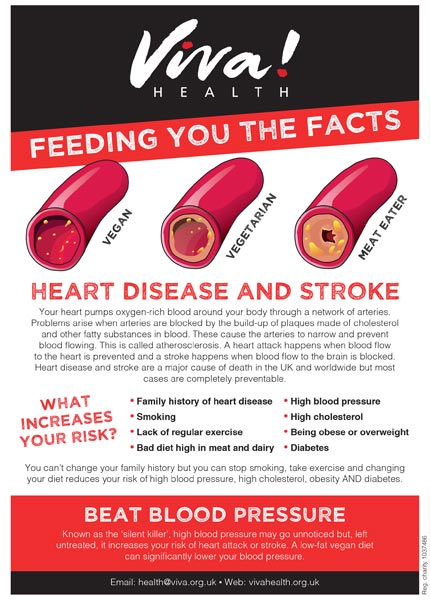
People with a high level of iron – usually caused by meat
eating although there can also be a genetic link – are more
likely to die from heart disease (17, 18, 19, 20, 21, 22).
Another negative effect is its tendency to damage (oxidize)
the ‘bad’ form of cholesterol that clogs
arteries (low density lipoproteins, or LDL). When LDL cholesterol
is damaged it becomes even more dangerous than normal as
the chemical reaction involved is thought to directly damage
heart cells, making this a two-pronged attack (20).
The evidence against haem iron is growing and it has been
shown that high iron stores from red meat increase the risk
of heart disease, particularly in older men and women (21).
Another study
has shown an increased risk of heart attacks among meat-eating
males generally and came to the conclusion that there was
a direct association between meat intake, high haem iron
stores and heart disease (22). Yet more research has shown
that high iron stores and a high dietary iron intake are
strongly linked to heart disease (20).
Haem Iron and Diabetes
Excessive iron stores can also affect
the body’s ability
to regulate insulin production, which is the first warning
sign of diabetes. This ‘insulin resistance’ can
go on to cause full-blown adult onset diabetes mellitus (type
2 – non-insulin dependent diabetes). There is now a large
body of research to show that insulin resistance is directly
related to iron stores -the lower the stores, the less the
risk of insulin resistance and the less chance of developing
diabetes. It’s also clear that vegetarians and vegans
have lower insulin resistance than meat eaters and a lower
risk of diabetes. The higher diabetes risk for meat eaters
is primarily due to their diet. Not surprisingly, the conclusion
of these studies is that there would be fewer cases of adult-onset
diabetes in meat eaters if they lowered their iron stores.
It’s a scientific way of saying ‘give up meat’ (23,
24, 25, 26).
Baby Blues
Anaemia in infants is surprisingly common and
poses a major problem in the UK. At six months old, an infant’s
requirements for certain nutrients increase, therefore advice
from professional bodies such as the British Dietetic Association
and the Department of Health is that they should have started
weaning by this age. One reason is that the volume of milk
required to meet a baby’s energy and nutrient needs,
such as iron, is too great for breast milk alone to supply.
From six months old, an infant’s iron requirements
increase from 4.3mg (4-6 months) to 7.8mg (6 months). Body
stores of iron in a baby are depleted by this age and additional
iron is required. Research and real-life practice show this
to be true for infants who have been fed breast milk or cow’s
milk formulas. The primary cause of anaemia in infants is
therefore inappropriate weaning – too early, too late or
an unbalanced diet.
Feeding babies whole cow’s milk is part of the problem
because of its low iron content and the fact that what iron
there is, is poorly absorbed. Milk also inhibits the absorption
of iron from other foods. Even worse, allergy to cow’s
milk is widespread and frequently results in unseen intestinal
bleeding, with considerable quantities of iron being lost
in the blood (2, 27, 28, 29). It is a major problem and in
the USA, for example, 15 to 20 per cent of infants have anaemia,
about one half of which is caused by cow’s milk.
Summary
- Iron is a mineral found in the haemoglobin molecules
of all red blood cells and is essential for healthy cells
and oxygen transport around the body.
- There is no difference in the incidence of iron deficiency
anaemia between vegetarians/vegans and meat-eaters.
- Rich plant sources of iron include legumes (peas, beans
and lentils), soya bean curd (tofu), nuts, seeds, wholegrains
and dried fruits. Many breakfast cereals are fortified
with iron.
- The daily recommended intake for iron in the UK is 8.7mg/day
for men and 14.8mg/day for women up to age 50 years.
- There are two types of iron – haem from meat sources
and non-haem from plants.
- Haem iron is rapidly absorbed and continues to be absorbed
and stored whether the body needs it or not. Plant iron
is more slowly absorbed.
- The body regulates the amount of non-haem iron it absorbs,
taking only what it needs for healthy levels to be maintained.
- Absorption of plant iron is improved by including vitamin
C with the same meal.
- High iron stores as a result of eating meat are a known
risk factor for heart disease and diabetes.
- Anaemia in infants is a major problem in the UK and much
of it is linked to cow’s milk and cow’s milk
formulas as dairy is low in iron and inhibits iron absorption
from other foods. Allergies to cow’s milk are common
worldwide and can cause intestinal bleeding in infants
– another cause of anaemia in young children.
It is not necessary to eat meat in order to obtain iron
– in fact, iron from meat can be bad for us. Plant-based
diets which include iron-rich foods, backed up with fruits
and vegetables rich in vitamin C, will ensure enough – but
not too much – iron and is one of the reasons that vegetarians
have a clear health advantage over meat eaters.
References
- National Diet and Nutrition Survey – Adults
Aged 19-64 yrs, Food Standard Agency, 2003, Volume
3: Vitamin and Mineral Intakes, p 69-71
- J L Groff, S S Gropper, and S M Hunt, 1995,
Advanced Nutrition and Human Metabolism, Second Edition,
Ch 12, p 353-366
- McCance and Widdowson’s, 1998, The Composition
of Foods, Fifth Edition, Royal Society of Chemistry
and Ministry of Agriculture, Fisheries and Food
- Department of Health, 41: Dietary Reference
Values for Food Energy and Nutrients for the UK, Department
of Health, First Edition, Ch 28, p 161-167
- B Thomas (in conjunction with the British Dietetic
Association), 2001, Manual of Dietetic Practice, 3rd
Edition, Blackwell Science, Ch 3.3, p 231-46
- S Walsh, 2003, Plant based nutrition and health,
First Edition, The Vegan Society, Ch 11, p 122-125
- D C Sharma et al, 1995, Correlation of anaemia
and iron deficiency in vegetarians by administration
of ascorbic acid, Indian J Physiol Pharmacol, 39, 4,
p 403-406
- J R Hunt et al, 1990, Ascorbic acid; effect
on ongoing iron absorption and status in iron-depleted
young women, American Journal of Clinical Nutrition,
51, p 649-655
- W J Craig, 1994, Iron Status of Vegetarians,
Am J Clin Nutr, 59, Suppl, p 1233S-7S
- R F Hurrell et al, 1992, Soy protein, phytate
and iron absorption in humans, Am J Clin Nutr, 56,
p 573-578
- L Hallberg et al, 1991, Calcium: effect of
different amounts on non-heme and heme iron absorption
in humans, Am J Clin Nutr, 53, p 112-119
- J S Garrow, WPT James, 1996, Human Nutrition
and Dietetics, Edition 9, Ch 12, p 174-208
- Research Bulletin 7, Fe – Iron and Vegetarians:
A Cause for Concern? The Vegetarian Society.
- R S Gibson, 1990, Principles of nutritional
assessment, First Edition, Oxford University Press,
Ch 17, p 349-372
- L Hambraeus, 1999, Animal – and plant-food-based
diets and iron status: benefits and costs, Proc. Nutr.
Soc, 58, p 235-242
- ADA Report, 2003, Position of the American Dietetic
Association and Dietitians of Canada: Vegetarian diets,
103, 6, p 748-765
- Ma and Stampfer, 2002, Body Iron
Stores and Coronary Heart Disease, Clinical Chemistry,
48, No 4, p 601-603
- C T Sempas, 2002, Do body iron stores increase
the risk of developing coronary heart disease? Am J Clin
Nutr, 76, p 501-503
- A L Heath et al, 2003, Health implications of iron
overload: the role of diet and genotypes, Nutr Rev, 61,
No 2, p 45-62
- J T Salonen et al, 1992, High stored iron levels
are associated with excess risk of myocardial infarction
in Eastern Finnish men, Circulation, 86, No 3, p 803-811
- A Tzonou et al, 1998, Dietary iron and coronary
heart disease risk: A study from Greece, Am J Epid, 147,
No 2, p 161-167
- A Ascherio et al, 1994, Dietary iron intake and
risk of coronary disease among men, Circulation, 89, No
3, p 969-74
- R Jiang et al, 2004, Dietary iron intake and blood
donations in relation to risk of type 2 diabetes in men:
prospective cohort study, Am J Clin Nutr, 79, p 70-75
- C S Kuo et al, 2004, Insulin sensitivity in Chinese
ovo-lacto vegetarians compared with omnivores, Euro J Clin
Nutr, 58, p 312-316
- N W Hua et al, 2001, Low iron status and enhanced
insulin sensitivity in lacto-ovo vegetarians, Bri J Nutr,
86, p 515-519
- J T Salonen et al, 1998, Relation between iron
stores and non insulin dependant diabetes in men: a case
control study, BMJ, p 313, 727
- V E Freeman et al, A longitudinal study of iron
status in children at 12, 24 and 36 months, Pub Health
Nutr, 1, No 2, p 93-100
- C W Thane et al, 2000, Risk factors for poor iron
status in British toddlers: Further analysis of data from
the National Diet and Nutrition Survey of children aged
1.5 – 4.5 years, Pub Health Nutr, 3, 4, p 433-440
- P B Sullivan et al, 1993, Cow’s milk induced
intestinal bleeding in infancy, Arch. Dis. Child., 68,
p 240-245
|
|
VVF Fact Sheets
|