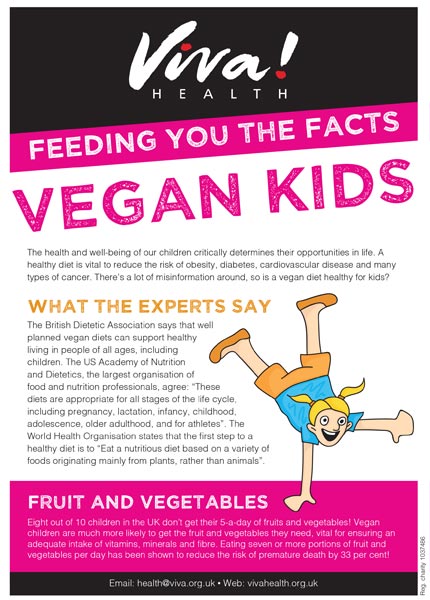

Why vegetarian and vegan diets are the healthiest and safest
option for children.
by Laura Scott (MSc Nutrition) VVF Snr Nutritionist
Plant-based diets offer the perfect vehicle for promoting
healthy eating patterns in childhood, helping reduce the
risks of developing many degenerative diseases in later life.
Animal Products Promote Disease
Meat and dairy products promote disease. They are high fat
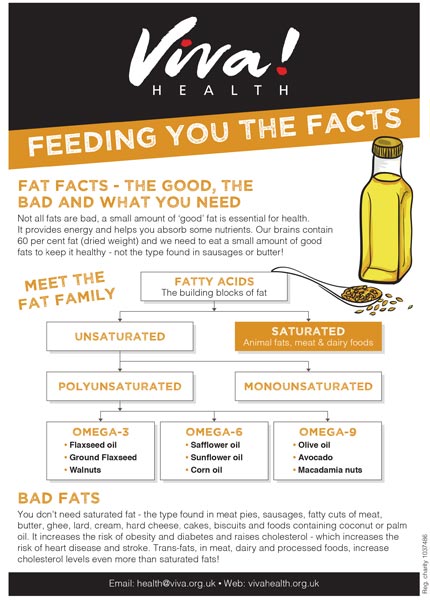
foods, a primary source of unhealthy (and inessential) saturated
fats and cholesterol, contain no fibre, no complex (starchy)
carbohydrate, none of the primary antioxidant (disease-busting)
vitamins – C, E, and beta-carotene (the antioxidant form
of vitamin A) and no vitamins E or K.
Vegetarian Diets Promote Good Health
Balanced vegetarian diets on the other hand protect health.
Fresh fruits, vegetables, wholegrain cereals, nuts, seeds
and vegetable protein sources such as soya (including fortified
soya milks), beans and lentils provide all the nutrients
eg. vitamins, minerals, protein, fibre, starchy carbohydrate
and essential fats the body needs without the harmful saturated
fat and cholesterol that animal products provide. Nutritional
myths abound when vegetarian diets are discussed but a look
at the science behind the claims shows that these are just
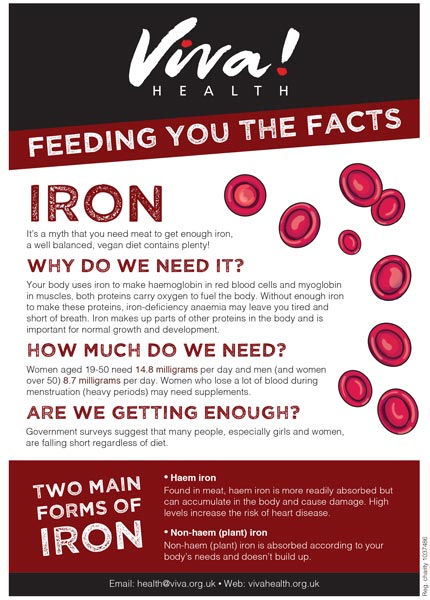
that – myths to be dismissed! Take iron – a mineral that
is found in many foods such as beans, wholegrains and dried
fruit and whose absorption is increased when taken with vitamin
C. Both the British Medical Association and the American
Dietetic Association clearly state that iron deficiency anaemia
is no more common in vegetarians than meat-eaters (1,2).
Every leading health advisory body is saying the same thing
– Western societies need to get away from eating animal products
and turn to plant foods to ensure good health. There is no
one element or ‘magic bullet’ in a meat-free
diet – it is the totality of a vegetarian diet that is the
secret of vibrant lifelong health.
What Are Children Eating?
Rubbish apparently. A Government survey published in June
2000 on the diet and nutrition of 4 to18 year-olds found
that roughly 80% of children are guzzling away on white bread,
savoury snacks, biscuits, chips and chocolate confectionery.
Roughly 60-75% had not eaten any citrus fruits or leafy green
vegetables in the week of the survey (3). Children are eating
a diet low in many of the vital health-promoting vitamins
and minerals needed to help combat disease and a diet high
in disease-promoting foods such as high fat, high salt and
high sugar convenience-type foods. Meat and dairy products
are still firmly placed at the centre of most meals.
The Right Start in Life for children
Diets based on animal products are quite simply leaving
children unprotected in the health stakes. Encouraging children
to adopt healthy eating practices from a very early age will
mean that they will grow up choosing foods that will promote
their good health not promote their ill health. Study after
study proves that not only are vegetarian diets perfectly
safe but have significant advantages over meat-based diets.
Recent research comparing omnivore and vegetarian children
found that vegetarian children had lower intakes of total
and saturated fat, cholesterol and sodium and higher intakes
of beneficial antioxidant (disease-busting) nutrients such
as beta-carotene (the antioxidant form of vitamin A), vitamins
C and E (4).
How Animal Products Affect Children
Allergies and Food Intolerances
Food intolerances to cow’s milk are increasingly common
in both children and adults alike. Many children display
an intolerance to the protein in cow’s milk (casein)
with symptoms such as diarrhoea and vomiting being an indication
of a problem (5). Whole cow’s milk is also a cause
of milk-induced gastrointestinal blood loss which may contribute
to the development of iron deficiency anaemia (6). Cow’s
milk is also being investigated as a possible cause of Cot
death (7). The advice to parents now is that whole cow’s
milk should not be given during the first year of a baby's
life (8). Children and adults can also be intolerant to the
sugar (lactose) found in cow’s milk. Contrary to what
the dairy industry would have us believe lactose intolerance
is actually the norm for human populations – testified by
the fact that some 75% of the world’s population can’t
digest lactose! (9). The enzyme required to break down milk
sugar (lactase) is only required up to weaning – after this
time there is no biological requirement to drink milk and
certainly not the milk of another species! (10).
Cancer
Over a third of cancer deaths – and possibly many more -
may be linked to diet. Getting the diet right at the very
outset of life is crucial in minimizing the chances of developing
this disease. Vegetarians are at a reduced risk for some
cancers and there are a number of reasons for this. A diet
high in fresh fruits and vegetables is now recognised as
being one of the most important ways to help ward off cancer
and of course these foods are typically abundant in good
plant-based diets (11). Plant foods contain high levels of
antioxidants – disease-fighting vitamins such as vitamins
A, E and beta-carotene as well as fibre. Breast, prostate
and colon cancer are all linked to the consumption of animal
products such as dairy foods and meat (12, 13, 14). Eating
high amounts of red meat (particularly processed red meat)
eg. beef, veal, pork and lamb, is known to be associated
with a 20-40% increase in colorectal cancer risk (15).
Diabetes
Diabetes is a group of disorders all leading to rises in
blood glucose (sugar) levels due to the inaction of insulin
– a hormone that takes glucose out of the bloodstream and
into body cells. There is increasing evidence from a number
of studies to show that early exposure to cow’s milk
may be a trigger for type I diabetes -the early on-set form
of diabetes. One possible reason could be due to the cow’s
milk destroying the cells in the pancreas that secrete insulin
(16). Worldwide cases of now wrongly named adult on-set diabetes
or type II diabetes already top 150 million cases and numbers
are set to rise dramatically. 80% of sufferers are overweight
and the first cases of teenagers being affected by type II
diabetes have been observed – all the sufferers being overweight.
There is now very clear evidence that plant-centred, high-fibre,
moderate protein/fat diets can greatly improve diabetic control
and reduce the risks of it occurring in the first place (17).
Food Poisoning
Eating animal products causes 95% of all cases of food poisoning
and children are particularly vulnerable. A complication
of infection with E.coli 0157 is now thought to
be the biggest cause of acute (short-term) kidney failure
in children. Farmed animals, in particular cattle, are thought
to be the reservoir of infection (18).
Heart Disease
Incredible as it may seem, autopsy studies in children clearly
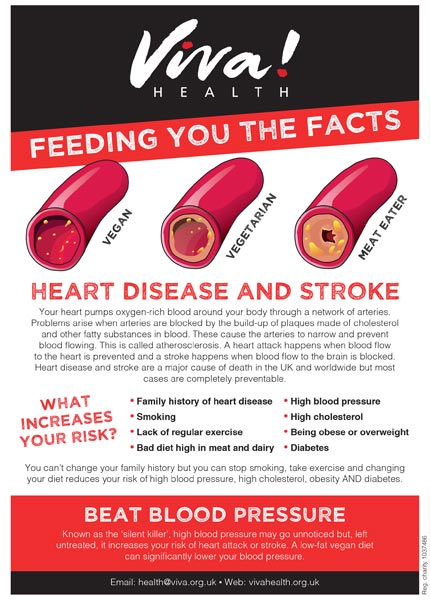
demonstrate that the first signs of atherosclerosis (clogged-up
arteries) is occurring at a very young age – a first step
in the lead up to heart disease (19). Cardiovascular disease
is the number one killer in the UK but the chances of dying
from heart disease are greatly reduced by some 25% by going
meat-free (20). Why? Vegetarians are, as a group, leaner
and have lower blood pressure levels and cholesterol levels
than comparable meat-eaters – both major risk factors for
heart disease (1).
Osteoporosis
Osteoporosis – brittle bones – may be a disease we associate
with old age but the prevention of it is firmly rooted in
childhood. Peak bone mass is reached by the time someone
is in their mid-30’s so it is crucial that young people
look after their bones from an early age. Obtaining calcium
from drinking cow’s milk is no guarantee of good bone
health since there are a whole host of factors involved in
making bones strong such as hormonal levels, activity levels
and of course dietary issues (21). Whilst calcium is important
in the diet what is equally important is holding onto this
calcium. Animal products tend to cause bones to lose their
calcium (due to their acidic nature) whereas plant proteins
tend to encourage bones to hold onto it (22). Keeping active
from an early age is crucial in maintaining good bone health
as is the limiting of high intakes of salt and phosphorus
derived from junk food diets and fizzy drinks.
Weight Problems
Currently, over half of women and about two thirds of men
as well as at least 10% of children are classed as overweight
or obese. The World Health Organisation states that obesity
is linked to heart disease, high blood pressure, diabetes,
osteoarthritis, gall stones and some cancers and that prevention
is the key to tackling weight problems. The 1991 Bogalusa
Heart Study showed that even mild obesity in childhood is
related to higher levels of blood pressure, insulin and cholesterol
levels and that to some extent these track into adulthood
(23). Numerous studies show that vegetarians are leaner than
meat-eaters (24, 25).
Humans – A Vegetarian Species
What is becoming abundantly clear is that the type of degenerative
diseases we tend to associate with adulthood are now beginning
to occur in childhood. Weight problems, type II diabetes
and the first signs of heart disease are just some of the
major degenerative diseases that children are at risk of
– both in childhood and in adulthood. For the first time
in a century, life expectancy in the UK is set to fall as
obesity and associated diseases such as diabetes and heart
disease take their toll. The reason? – a junk food, meat
and dairy-centred diet and chronic lack of activity. The
cure? – a diet that provides all the necessary protective
foods and rejects all the dangerous ones. Scientific evidence
clearly shows us this means plant-based not animal-based
foods. We are a vegetarian species and ignore our evolutionary
past at our peril. As Professor Colin Campbell -Professor
of Nutritional Biochemistry at Cornell University and one
time senior science advisor to the World Cancer Research
Fund states: "The closer one approaches a total plant
food diet, the greater the health benefit...Animal foods,
in general, are not really helpful and we need to get away
from eating them." (26, 27).
Balanced plant-based vegetarian and vegan diets can extend
healthy life expectancy by greatly reducing the risks of
many degenerative diseases. Bringing your child up on a meat-free/dairy-free
diet is, without doubt, the very best life insurance policy
you could ever give them.
Summary
- Balanced vegetarian and vegan diets are perfectly safe
for infants and children alike and are amply able to provide
all the nutrients the body needs.
- Diets based around plants promote health – diets based
around meat and dairy products promote disease.
- Vegetarian children have healthier diets than their meat-eating
omnivorous peers.
- Vegetarian diets promote healthy eating patterns in childhood.
- Many degenerative diseases are caused by an over-reliance
on animal products.
- Vegetarians, as a group, have a reduced risk of heart
disease, diabetes, some cancers and obesity.
- Humans have the bodies of a vegetarian species – our
risk of disease is increased by eating animal products.
References
1 American Dietetic Association, 1997. Position of the American
DieteticAssociation: Vegetarian Diets.
2 BMA, 1996. Diet, Nutrition and Health. BMA Report;4-11.
3 National Diet and Nutrition Survey: Young People aged 4
to 18 years. Vol. 1:Report of the Diet and Nutrition Survey.
London Stationary Office June 2000.
4 Thane CW and Bates CJ, 2000. Dietary Intakes and Nutrient
Status of Vegetarian Preschool Children from a British National
Survey. J. Hum. Nutr. Dietet.;13:149-162.
5 Iacono G et al, 1998. Persistent Cow's Milk Protein Intolerance
in Infants: The Changing Faces of the Same Disease. Clinical
and Experimental Allergy;28:817-823.
6 Sullivan PB, 1993. Cow's Milk Induced Intestinal Bleeding
in Infancy. Archives of Disease in Childhood;68:240-245.
7 Collins S, 11/04/99. Scientists Link Cow’s Milk with
Cot Deaths. Sunday Mirror.
8 Committee on Nutrition, American Academy of Pediatrics:89(6):1105-1109.
9 Srinivasan R and Minocha A, 1999. When to Suspect Lactose
Intolerance:Symptomatic, Ethnic and Laboratory Clues. Postgrad.
Med.;104(3):109-123.
10 Oski F. 1983. Don’t Drink Your Milk!. p.46. (Teach
Services).
11 Key TJ et al, 2002. The Effect of Diet on Risk of Cancer.
The Lancet;360:861-868.
12 Bingham SA et al, 2003. Are Imprecise Methods Obscuring
a Relation Between Fat and Breast Cancer? The Lancet;362(9379):212-214.
13 Chan JM et al, 2001. Dairy Products, Calcium and Prostate
Cancer Risk inthe Physicians Health Study. American Journal
of Clinical Nutrition;74:549-554.
14 Norat T et al, 2002. Meat Consumption and Colorectal Cancer
Risk: Dose-Response Meta-Analysis of Epidemiological Studies.
International Journal of Cancer;98:241-256.
15 Riboli E, 22nd
June 2001. Meat, Processed Meat and Colorectal Cancer. EPIC
Study – Preliminary Results.
16 Karjalainen J et al, 1992.
A Bovine Albumin Peptide as a Possible Trigger of Insulin-Dependent
Diabetes Mellitus. NEJM;327(5);302-307.
17 Chandalia M et
al, 2000. Beneficial Effects of High Dietary Fibre Intake
inPatients with Type 2 Diabetes Mellitus. NEJM;342:1392-1398.
18
Prof. E Goldman (Ed.), 2001. Stop Bugging Me. p.11 (Viva!
Campaigns Ltd).
19 Berenson, GS et al, 1988. Association Between
Multiple Cardiovascular Risk Factorsand Atherosclerosis in
Children and Young Adults. N Engl J Med; 338:1650-56.
20 Key
TJ et al, 1999. Health Benefits of a Vegetarian Diet. Proc.
Nutr.Soc.; 58:271-275.
21 World Health Organisation, 1991. Diet, Nutrition
and the Prevention ofChronic Diseases. p.24.
22 Remer T and
Manz F, 1994. Estimation of the Renal Net Acid Excretion
byAdults Consuming Diets Containing Variable Amounts of Protein.AJCN;59:1356-1361.
23
National Forum for Coronary Heart Disease Prevention, May
1993. Food For Children: Influencing Choice and Investing
in Health. p.20.
24 Burr ML et al, 1981. Plasma Cholesterol
and Blood Pressure in Vegetarians. J. Human Nutr.;35:437-441.
25
Appleby PN et al, 1998. Low Body Mass Index in Non-Meat Eaters:
The Possible Roles of Animal Fat, Dietary Fibre and Alcohol.
Intl. J. Obesity;22:454-460.
26 Barnard ND, 1994. The China
Diet and Health Study. Good Medicine vol.III, No.3, p.11.
27 The Arizona Daily Star, Tuscon, 9 May 1990. p.14.
|
|
Click here to buy our factsheets
VVF Fact Sheets
|